
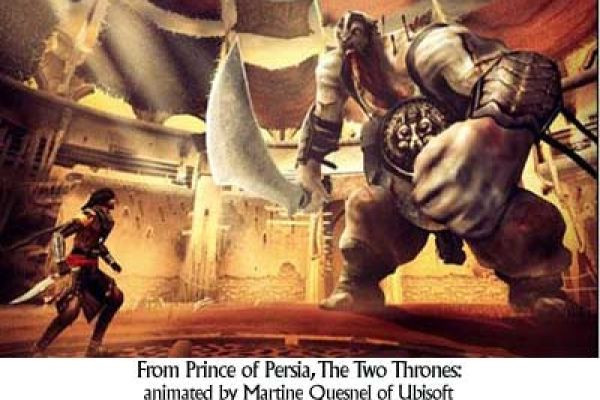
The venerable art of animating still images has existed in some form or another since the 1800s. Today, however, new evolutionary offshoots of the artform make the industry more diverse than ever. Video Games in particular, offer a variety of opportunities and restrictions not found in previous forms of animation.
Regardless of the platform, video games offer a cornucopia of rich animation, be it in the Full Motion Video cut-scenes or the abundant in-game engine animations. FMV can be either hand drawn or CG, and is generated in much the same way one would produce content for film or video. With limited or non-existent user input, FMV sequences are mostly employed for narrative purposes. The in-game engine animations are the real source of the mediums' potential. It is here that a talented artist is able to tell a story using body language and limited graphics. "How a character walks (e.g. slouching sadly or bouncing happily) is telling the character's story," points out Sam Yip.
Sam Yip is a senior animator at Disney Interactive. His portfolio includes such games as "Pirates of the Caribbean Online," "Saints Row," and "Golden Eye: Rogue Agent." A fan of both traditional animation and recent interactive mediums, he believes the major distinction between games and film lies within the mediums' objectives. "The goal of [film] animation is to serve a story/narrative, and in video games, the animation's goal is to serve the game play, so the game player can create his own story."
While voice over and scripted story sequences are common place in today's games, the artist's task is to inject as much personality into the player's avatar as possible. Yip reminds us that "Video game animations will have a lot of body movements such as running, walking, swinging a sword, and a lot of them will be cycled." This is where many genre restrictions come into play. Since a player commands the character, an artist is given the task of creating believable movements that can be transitioned to at a moment's notice. Much of this affects how anticipation is handled.
Geen reacties gevonden
admin
105 Bekeken · 3 jaar geleden
admin
81 Bekeken · 3 jaar geleden
admin
79 Bekeken · 3 jaar geleden
admin
77 Bekeken · 3 jaar geleden
admin
73 Bekeken · 3 jaar geleden
Relaxing Sleep Music, Nature, Deep Sleeping Music, Relaxing Music, Stress Relief, Meditation Music.
admin
71 Bekeken · 3 jaar geleden
